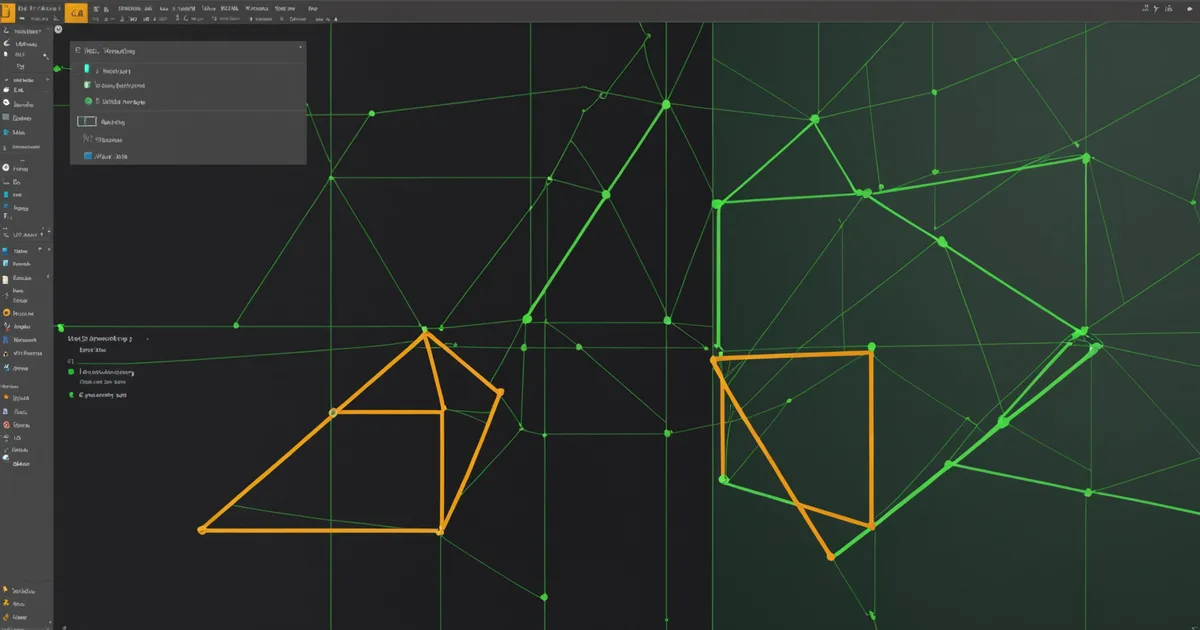
The choice between bounding box and polygon annotation is downstream of your model architecture and your downstream use case. It's not purely about precision. A polygon annotation on a dataset where your model only outputs boxes is wasted annotation effort. A bounding box on a dataset headed for instance segmentation is a data quality problem. The decision starts with what your model needs, not what's easier to draw.
When bounding boxes are the right choice
Bounding boxes are appropriate for any object detection architecture that outputs axis-aligned boxes: YOLO variants, SSD, RetinaNet. They're also appropriate when your downstream task is detection rather than segmentation. If the question is "is there a vehicle in this region," a box is sufficient to train for that. The model doesn't need pixel-level boundary information to learn to detect.
Annotation speed is a practical factor. A well-placed bounding box takes 3 to 5 seconds from a skilled annotator. A tight polygon around an irregularly shaped object can take 30 to 60 seconds depending on complexity. For a dataset of 50,000 frames, the difference is between 42 person-hours and 420 person-hours for the annotation pass alone. If your model outputs boxes and your task is detection, you're paying a 10x annotation cost for label information your model can't use.
Bounding boxes are also preferable when objects are regularly shaped (vehicles, pedestrians, sports equipment), densely packed (a shelf of products), or partially occluded in ways that make polygon boundary placement ambiguous. The ambiguity cost in polygon annotation, where different annotators place polygon vertices differently on occluded boundaries, often exceeds the precision benefit for these object types.
When polygons justify the cost
Polygons are necessary for instance segmentation tasks where the model needs to learn object boundaries, not just locations. Mask RCNN and its successors need polygon or mask labels to train the segmentation head. Using bounding boxes as a proxy trains a weaker segmentation model; the model compensates with rough circular or rectangular masks and loses the boundary precision that segmentation is supposed to provide.
Polygons are also appropriate when objects are highly irregular in shape and overlap in ways where boxes have substantial non-object area. A tree canopy, a leaf shape, an irregular industrial component: for these, a bounding box may include 40 to 60% background pixels, and the model is being trained on that included noise. If your detection task is precision-critical, polygons reduce the noise that bounding boxes introduce on irregular shapes.
The other justification for polygons is when your dataset will serve multiple downstream tasks. A polygon label can be converted to a bounding box by taking the min/max vertex coordinates. A bounding box cannot be expanded to a polygon. If you anticipate running both detection and segmentation experiments from the same dataset, annotating polygons once is cheaper than annotating boxes now and polygons later.
The pre-labeling dimension
Pre-labeling changes the annotation speed equation for both types. For bounding boxes, a pre-labeler that produces an initial box reduces annotator work to correction: adjust two corners, verify the label, accept. For polygons, the value of pre-labeling depends on how well your model's predicted boundary matches the real object boundary. A good pre-labeler on a common object class can produce a polygon that needs only minor vertex adjustment. A poor pre-labeler on an unusual shape may produce a polygon that's faster to discard and redraw than to correct. This means polygon pre-labeling delivers lower time savings than bounding box pre-labeling for object classes where your model is weakest, which is often precisely the classes where you need the most annotations.
Mixed annotation types in a single dataset
Production CV datasets often need more than one annotation type. An autonomous driving dataset might use bounding boxes for vehicles and pedestrians, polygons for free-space segmentation, and keypoints for traffic sign recognition. Managing multiple annotation types in the same dataset requires clear per-class annotation type assignments documented in the labeling guide, and annotation tooling that supports switching between modes without requiring separate annotation passes.
The QA implications of mixed annotation types are significant. Bounding box QA, which relies on IoU thresholds, doesn't apply to polygon annotations where the correct metric is Dice coefficient. Running a unified QA pass that applies the wrong metric to the wrong annotation type produces misleading quality scores. Per-class QA pipelines with class-appropriate metrics are more setup work but produce annotation quality measurements that actually predict model performance.
Export format implications for bounding box vs. polygon annotations
COCO JSON format handles both bounding boxes and polygons, but the segmentation field for polygons carries the vertex coordinate list rather than a binary mask. Some training frameworks that expect COCO format assume the segmentation field will be present but may not handle the polygon representation correctly without explicit configuration. Before committing to polygon annotation for a dataset, verify that your training pipeline reads COCO polygon coordinates correctly and converts them to masks at training time, or plan an explicit conversion step in your data preprocessing.
YOLO format stores bounding boxes as normalized center-x, center-y, width, height. It does not natively support polygon annotations. Teams that annotate polygons and train YOLO models need to convert polygons to bounding boxes at export time, which requires a coordinate transformation that some export tools handle automatically and others require scripting. Verifying the export pipeline before the annotation pass avoids discovering the format mismatch after 50,000 polygon labels have been created.
Class-level annotation type decisions
The annotation type decision should be made per class, not per dataset. A dataset for a recycling sorting system might use bounding boxes for large container classes (bottles, cans) and polygons for flat irregular items (paper, cardboard) where the shape boundary is needed to distinguish overlapping items. Documenting these class-level decisions in the labeling guide before annotation starts prevents ad-hoc decisions by annotators that produce inconsistent annotation types within a class.
Reviewing the class-level type decision at each dataset iteration also makes sense. A class that started with bounding boxes because the model was in early development may warrant upgrading to polygons once the team decides to add a segmentation head. Having the original annotation versioned and the rationale documented makes this upgrade decision more tractable than re-examining the original class-type assignment from scratch.
Annotate bounding boxes and polygons in Annotgrove